 The Germans saw the release of a car whose sales will happen very far from there, at both directions. This car represents one more application of the VW Group’s latest compact sedan project, which hit the streets under so many different badges and names that it became hard to follow. However, as VW wants this one to succeed at both Brazil and China, they tried to recover old Santana’s prestige by using its name again, although in a completely different car. Does all this seem confusing? Not after you’ve read this article.
If you’re staring at this pictures with a heavy déjà vu feeling, it’s not in vain. Do you remember GM’s J-Project at the eighties? They sold it as Chevrolet and Vauxhall Cavalier, Chevrolet Monza, Holden Camira, Opel Ascona and other ones which even included a Cadillac Cimarron, all of them the same car only with minor design changes, according to each brand’s rules. Now this strategy has been repeated by VW with a global project whose variations have started with the Russian Polo Sedan, who’s sold in other countries as Vento and has no relations with the hatchback. But as it follows the European Polo’s refinement level, there was created a simpler version of this project, in order to sell at the emergent markets with more competitive prices. Its first apperance was as Škoda Rapid, which makes sense because this is the group’s low-cost brand, but the next one was the most recent Seat Toledo: forgetting the big mess made by the Spanish division with this name in the past few years, how to justify that this sedan is being sold along with its twin brother at some markets and at similar price ranges? Another fun fact is that they’ve made a second Rapid exclusively to Indonesia, rebadging Polo instead of the cheaper variation.
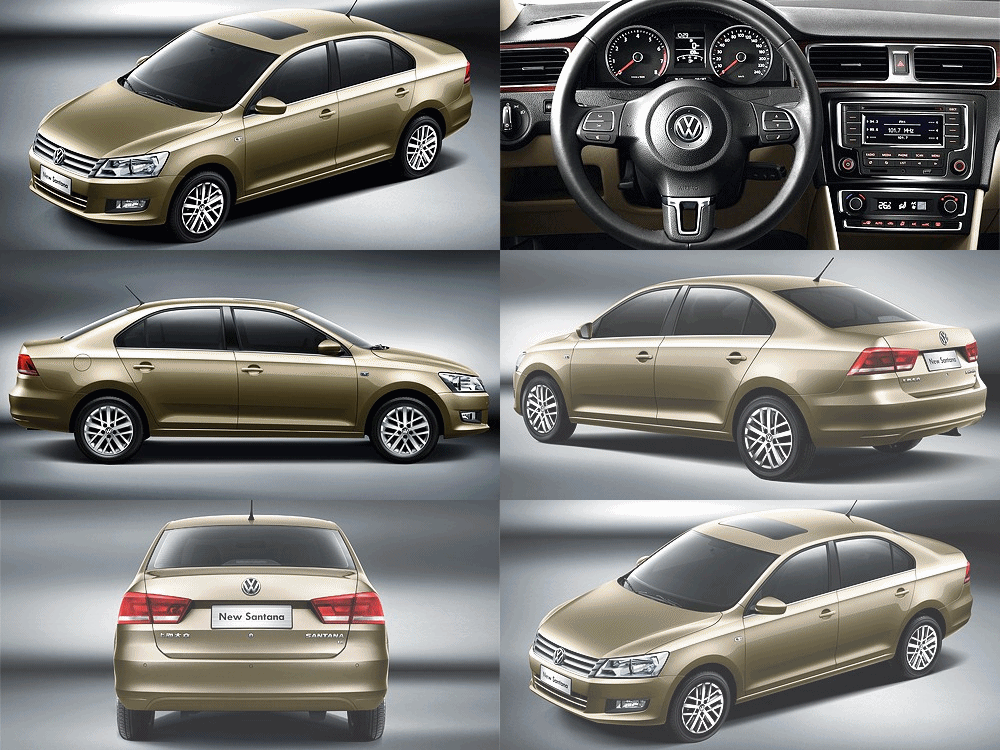 Clicking at the highlighted names it’s possible to notice that their differences are visually small, but big when it comes to manufacture: besides of the front and rear customary differences, Polo and the Indonesian Rapid’s windows design begins before the front door with a little plastic piece and ends after the rear door, with a fixed third window. The new Santana, on the other hand, belongs to the other group: their glass area is slightly smaller and their doors drawing was a little bit increased, in order to make this area fit between the doors – it’s a little uncommon to see rear doors that wide, but some costs were reduced by eliminating those two extra pieces. And if you’re not Brazilian or Chinese, you must be wondering why Santana is such an important name to them. This car came to the first country at the early eighties as Brazil’s first luxury VW; it was nothing more than a second-generation Passat, with minor changes to suit some regional preferences. China started to import the car from Brazil a few years later, but they didn’t take long to start their own production, keeping the name. Santana was very well-accepted at both markets at first because of its luxury and internal space, along with strong and resistant engines. The decade ended with the third Passat’s arrival at Europe, but both countries skipped its offering due to the high prices with whom it would be sold, appealing to regional solutions.
Brazil invested at a big redesign of that car, focusing at the aerodynamics to follow the 1990s trends but trying to keep the costs to a minimum: this strategy brought an elegant car for that time’s standards, but it was odd to see that not only the basic structure was kept from the older car as also its doors. But nothing seemed to stop the 90s-car-with-80s-doors’ excellent sales, in both markets. Santana’s situation begun to change only at the early 2000s, because it became increasingly hard to sell a luxury car among so younger and more sophisticated competitors. So VW decided to change their strategy, and the sedan started to lose items. It begun to focus at offering plenty of space and power at the same price of smaller cars, which ended up giving it huge success at the taxi business, also because it was very cheap and easy to repair. Brazil ended Santana’s production at 2006, but China kept selling it and at three phases: the Brazilian face-lift had the company of a Chinese one and even with the first generation, all of them with good sales. Now they want to sell this new sedan using the excellent reputation earned by the original Santana, but this decision falls into the same nonsense as selling the latest Beetle with the same name of the first one in each country: if the old Santana was a B2 Passat later heavily redesigned, the car at this article’s pictures is slightly related to the current Polo, a thirty-year younger car and two levels smaller at VW’s options (under Passat and Golf).
The Chinese Santana follows the latest trend among the compact sedans, which consists of offering mid-sized internal space and huge trunk along with good equipments list and not so refined construction, in order to achieve a reasonable final price. This recipe became famous with the first Renault Logan, and is now followed by Chevrolet Cobalt, Nissan Versa and Fiat Grand Siena, the only one among these yet to be sold outside its homeland (it was projected at Brazil). Santana will arrive at China with plenty of comfort and security items, such as alloy wheels, digital air-conditioner, electric sunroof, leather seats and ABS brakes, stability control and many airbags. Among the Comfortline, Trendline and Highline versions, it’ll use a 90-hp 1.4 and a 110-hp 1.6. You can read about Santana’s project “siblings” here, clicking at Škoda Rapid and Seat Toledo.



 HP 430 9PA


