Showing posts with label 4x4. Show all posts

Friday, March 15, 2013

Land Rover Range Rover 4

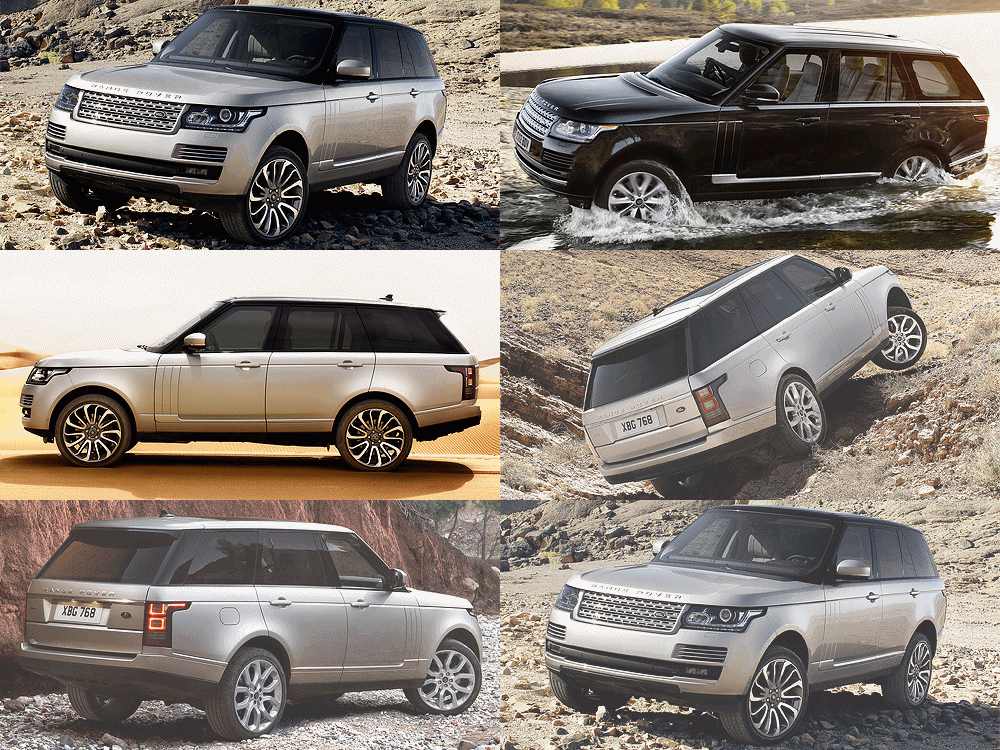
Land Rover Range Rover AutobiographyInovação é uma parcela muito grande do conjunto de estratégias de qualquer empresa que tenha pelo menos um mínimo de participação no mercado, mas ainda mais importante que ela é a adaptabilidade. O ato de reconhecer que a vontade do público não só muda com muita facilidade como o faz em uma infinidade de formas. São tantas que várias vezes incluem até mesmo não mudar. Este é apenas um dos intrigantes paradoxos que vêm garantindo o inquestionável sucesso deste fascinante SUV inglês por mais de quatro décadas.

Em outras palavras, essa questão consiste no contraste de vontades vindo da maioria dos clientes com o costume de buscar as opções mais recentes de um produto desejado exercido ao mesmo tempo que preservam certas preferências por muitos anos sem a menor possibilidade de troca. O mercado de perfumes femininos, por exemplo, vende uma série de marcas e modelos mas ainda tem Chanel n° 5 entre os líderes, por várias décadas consecutivas. Situação parecida acontece com Coca-Cola, Nestlé e várias outras, em geral uma marca por segmento. É exatamente isso que mantém a demanda pelo Range Rover inabalável desde os anos 1970. Rivais vêm e vão com os conceitos mais diversos e das mais variadas marcas – incluindo a própria Land Rover, com o Evoque – mas a demanda pelo “Rolls-Royce do fora-de-estrada” permanece sem se abalar. Este aparente paradoxo se torna especialmente interessante porque na verdade é composto por outro paradoxo: se a estratégia simbolizada pelo epíteto mencionado seja seguida atualmente por uma variedade enorme de modelos, quem a criou foi o próprio Range Rover. A receita de tanto sucesso é associar a cabine digna de uma limusine a preparo mecânico suficiente para permiti-lo trafegar nos mais diversos tipos de terreno e com os climas mais adversos sem perder a elegância.

Falar em elegância pode fazer com que muita gente logo lembre dos farois e lanternas claramente inspirados nas luzes do Evoque, mas o fato é que a personalidade do irmão maior é muito mais profunda. Outro símbolo que provavelmente nunca vai mudar é a silhueta do Range Rover, mesmo que a combinação de teto com queda leve associado à traseira inclinada tenha tido seu auge na época da primeira geração. Esta parte guarda um detalhe interessante, aliás: enquanto vários hatchbacks exibem o chamado “teto flutuante” como um detalhe de estilo recente, o SUV inglês já podia trazer todas as colunas em preto desde a primeira geração, obtendo exatamente o mesmo efeito de fazê-las parecer unidas às janelas como um só elemento em preto brilhante, que ao não impedir o teto de manter a cor da carroceria faz este último parecer visualmente desconectado da mesma. Mas assim que você tiver conseguido desviar o olhar do incrível equilíbrio entre passado e presente que é o design exterior deste veículo, começa o momento de estender o fascínio ao interior. A fartura de espaço para cinco pessoas foi exaltada com o aumento de entre-eixos em relação ao antecessor, além de o revestimento em couro se oferecer nos mais variados tons para combinar com a igualmente ampla oferta de tipos de madeira, tudo para compor o ambiente que mais agradar ao abastado proprietário.

Passar à parte técnica do novo Range Rover sempre merece a menção da sua nova plataforma, que recebeu aumento na tecnologia embarcada para não só ganhar em resistência como também para uma excelente perda de peso, que em certas versões chega a 400 kg. Uma novidade ainda mais surpreendente é a evolução do sistema Terrain Response, que abandona a necessidade de o motorista alterar o modo de direção: agora é o próprio veículo que avalia a condição do terreno em que está para escolher os parâmetros mais adequados de estabilidade, suspensão e tração. Em paralelo, o interminável pacote de equipamentos inclui mimos extremos como quadro de instrumentos feito por uma tela LCD e o reprodutor de DVD para os passageiros do banco traseiro. As opções de motorização mantêm o câmbio automático ZF de oito marchas para todas as versões, que no Brasil começam com a Vogue 4.4 V8 biturbo movido a diesel, com potência de 339 cv e torque de 71,1 kgfm e preço de R$ 551.800. Ele também equipa a Vogue SE sob o preço de R$ 575.800 e a topo-de-linha Autobiography, que por sua vez fica em R$ 596.800 – este trem-de-força lhe faz acelerar de 0 a 100 km/h em 6s9 e chegar à velocidade máxima de 217 km/h. Porém, quem desejar força ainda maior pode trocar o diesel pela gasolina que move o 5.0 V8, responsável pelos 510 cv e 63,5 kgfm e pelo desempenho de 5s4 e 225 km/h, este com limite eletrônico. Esta unidade equipa as versões Vogue SE Supercharged, de R$ 583.800, e Autobiography Supercharged, de R$ 601.400.

Read more > Land Rover Range Rover 4

Sunday, March 10, 2013

Suzuki Jimny 2013

Suzuki Jimny 4SunQuem disse que veículos 4x4 de qualidade precisam ser grandes e pesados? Meses depois de trazer novidades para o SX4, a Suzuki agora se volta aos puristas do off-road com o começo da produção nacional do Jimny. As unidades da nova fase já estão disponíveis nas revendas, mas as novidades vão muito além da simples mudança de cidadania. Não se pode negar que ele mantém certos deslizes de antes, mas as qualidades do conjunto lhe tornam um jipe que executa sua proposta tão bem quanto rivais maiores e mais caros.

Mesmo uma rápida observação das imagens já permite inferir que o menor Suzuki brasileiro tanto é um modelo focado no ambiente fora-de-estrada como também é um projeto de idade considerável… e essas afirmações não deixam de ser fatos. Mas a outra verdade é que a primeira delas é a justificação da segunda. A proposta do Jimny é muito similar à de Lada Niva e, guardadas as proporções, Jeep Willys: oferecer excelente desenvoltura em trilhas acidentadas com um conjunto simples e de fácil manutenção em troca de o cliente abrir mão de qualidades mais subjetivas, como design moderno ou cabine luxuosa. Este nome foi usado pela primeira vez em 1970, após a Suzuki ter comprado o projeto da montadora Hope dois anos antes, esta também japonesa mas que nunca chegou a ter sucesso. Esta fase inicial de fato merecia comparação direta com o Willys ou mesmo nosso Toyota Bandeirante, porque era apenas uma versão menor do pragmatismo off-road dos dois últimos. A geração de 1981 ainda se encaixava nos critérios japoneses de carros kei, mas as evoluções que recebeu já indicavam que ele não demoraria a ser exportado para vários países – no Brasil, por exemplo, essa fase chegou na versão também chamada de Samurai. Ele ganhou melhorias mais importantes em 1995, mas um novo projeto já estava previsto para breve; trata-se da geração à venda até hoje, surgida em 1998.

Suzuki JimnyContudo, essa longevidade se torna uma vantagem para veículos como o Jimny porque é uma prova da qualidade de seu projeto. Ter apenas 3,65 m de comprimento colabora para reduzir peso (1.060 kg) e diâmetro de giro (9,8 m), além de que os 85 cv do 1.3 16v a gasolina levam seus quatro ocupantes muito bem. A única falha importante deste carro é a ausência de airbag duplo e freios ABS, mas que graças às novas leis nacionais será corrigida até o final deste ano. Fabricado em Catalão (GO), o Jimny incorporou tomada de ar no capô e os vistosos protetores externos, cuja cor grafite se estende às rodas aro 15” e aos parachoques redesenhados. Já a cabine teve os bancos renovados e ganhou sistema de som multimídia com Bluetooth, aumentando uma lista de série que inclui ar-condicionado, direção hidráulica e travas e vidros elétricos. Agora ele tem quatro versões, começando pela 4Work e seu preço de R$ 55.990. A 4Sun passa a R$ 59.990 porque soma o teto solar de lona visto nas imagens. Custando R$ 61.990, a 4Sport amplia o potencial off-road do jipinho com parachoques menores para aumentar os ângulos de entrada e saída, além de engates dianteiro e traseiro, detalhes externos em grafite como snorkel e rack de teto, moldura do painel na cor do veículo e volante de couro. Por fim, o preço da 4Work varia porque ela permite opcionais como pneus off-road, conjunto interior lavável e os outros itens já citados. Este modelo sempre traz tração 4x4 com reduzida opção de 4x2 traseira.

Read more > Suzuki Jimny 2013

Friday, March 1, 2013

Volvo S80, V70 and XC70 2014

Click to see in high resolutionIf you have at least around ten years of being a car fan, this article will give you a very pleasant déjà vu. It is focused on Volvo’s multiple facelifts, but when we have so many involved cars it’s impossible not to spend some time only to think what would be the best way of dividing them into this blog’s articles. So instead of dividing in sedans, wagons and off-roads, there will be two articles. The present one will take you back to those times when Volvos were very elegant square sedans and unforgettably boxy station wagons.

Even though this rear design has made these cars worldwide famous for decades, the reason why it was adopted was purely functional: having such an abrupt end of the roof minimized the aerodynamic drag, which helped to improve both performance and consumption, since there’s less power demanded from the car to perform a given movement. That’s why this design’s pioneer in Volvo, the 140 Series, used these concepts making concessions only to the cargo capacity, which resulted in 1968 Volvo 145’s hearse-inspired styling. The following years received the 240 Series and a younger design, but, like Opel would conclude in the mid-1990s after adopting the same concept, it really required forgetting any wishes of creating design-award-winning wagons. However, if the German automaker started to abandon it in favor of more inclinated rear windshields, Volvo decided to make them its own symbol. The 700 Series showed that the 1980s would only give the Swedish cars cleaner sheetmetal, with less strips and creases, and nothing more. After all, Volvo’s cars were already been very well-received due to the classical incomparable concern with the safety, but pairing it to such a particular design choice made these cars famous and impossible to mistake when seen on the streets – which can be easily interpretated as one of the very first examples of a successful visual identity.

Volvo V70 2014Another case of Volvo’s strong application of a design language has been produced right next to the station wagons, in all these decades: the sedans. Their concern wasn’t having the best aerodynamic or optimizing the trunk space (1983s Volvo 740’s, for instance, could fit an Europallet), but being classy and elegant. Since the 1960s models, it’s interesting to observe that Volvo’s sedans used to feature each and every design element known for avoiding a sporty styling and making the car look classical. Square lines, well-divided volumes with cab rearward, long and low-deck rear, third side window after the back doors… The last line to use this rigid recipe was 850, but both sedan and wagon became most known for a surprisingly well-accepted sporty potential: the turbocharged engines helped the great handling to deliver a very interesting performance that lasted until 1996. This concept would receive some changes only with S80 and V70, which became Volvo’s latest flagship cars. Their most notorious feature was the largely renewed styling, still carrying most of the traditional concepts but in a much more modern interpretation, with more fluid lines and smoother surfaces. Therefore, after presenting this new corporate design in the early 2000s, these cars were expected only to refresh the same style for some more years, just like at the previous phase. The impressive surprise came when the decision was to follow some of the new trends, but in Volvo’s own way.

Volvo S80 2014There were even more “subversive” releases, such as C30 and XC60, but their pioneer was much more discreet, and yet much more surprising: who would expect the first modern-times Volvo to come based on V70, the current phase of Volvo’s most traditional lineage? The 1997 Cross Country version is frequently mentioned at this blog for being one of the precursors of the current crossover trend, along with Subaru Forester. But besides of the always-commented great idea of joining some of the SUV’s off-road potential to a comfortable urban station wagon, the bigger merit goes to the automaker’s attitude of trying some of the new trends, at least as an experiment. The then-called V70 XC appeared as only one more trim level, but ended so well-received that it motivated a true SUV (XC90) and, some years later, even a much more urban crossover (XC60), not to mention the right to follow V70 on its next generations. This turned out a very nice example of how heavy changes actually can give positive results. In fact, following this train of thought some more led Volvo to release a whole group of “new-age cars”, but remodelling the entire line is something every brand is doing in nowadays. What makes the Swedish automaker different is the ability to reconcile the past idiosyncrasies with excellent interpretations of the modern trends.

Volvo XC70 2014And now you’ve reached the reason why this was the chosen division for these news. This article’s trio represents the traditional Volvos, which still include several of those mentioned elements, but with modern touches like the very clear narrowing of the transverse section when going to the windows’ height, and even a slight smoothening of the wagons’ rear design. Therefore, facelifting such classical cars could only end at the very nice changes they’ll receive for 2014. Being hard to notice is just one of their good characteristics, because their purpose is to update the cars without taking away their visual harmony. The front bumper was redesigned, featuring more aggressive design and wider grille, along with LED daytime lights for XC70. All of them will also offer 19” wheels, but only S80 received minor updates to both lights. Another addition is the Sensus Connected infotainment system, which uses the central console touchscreen, like usual, but with the interesting possibility of being operated by gloved hands; everyone who has lived at least one harsh winter will be very thankful for this solution. Besides all that, this trio maintains the engine and equipment offers, which consists in the very sophisticated interiors and XC70’s particular off-road items, such as all-wheel-drive and hill-driving control.

Read more > Volvo S80, V70 and XC70 2014

Monday, February 18, 2013

Jeep Grand Cherokee CRD

Clique para ver em alta resoluçãoVocê lembra do breve período em que a Chrysler esteve nas mãos da Mercedes-Benz? Iniciadas no final da década de 1990, as boas intenções da aliança salvaram a montadora norteamericana de graves problemas financeiros e pretendiam aumentar a competitividade mundial de ambas, mas levaram apenas a uma sucessão de problemas. Nos dias de hoje, a união com a Fiat dá cada vez mais provas de que foi uma decisão bem mais acertada. Para nós, a mais recente é esta versão do SUV que agora chega ao lançamento oficial.

Guardadas as proporções, as chamadas joint-ventures podem ser entendidas com uma breve associação ao conceito de casamento. Mais ou menos como com as pessoas, uma empresa se associa a outra quando se detectam interesses comuns, neste caso para efetivar a ideia de começar dividindo os custos para no futuro aumentar os lucros. Mas com a convivência também surgem os projetos comuns. Começam em geral com uma cedendo veículos à outra para vendê-los em outros mercados, e continua com o uso compartilhado de tecnologias e por fim plataformas – é a evolução que Ford e VW tiveram no começo dos anos 1990 no Brasil, com a Autolatina. Atualmente, a Chrysler está por concluir a separação da Mercedes-Benz, mas já se encontra desfrutando de muitos benefícios da união com os italianos. Ou seja, depois de começarem com carros como Fiat Freemont e mais tarde RAM ProMaster, hoje em dia os benefícios estão chegando também às esferas mais tradicionais. A divisão de luxo Lancia, por exemplo, já expandiu suas operações na Europa ganhando modelos da Chrysler e até vendendo outros com essa marca, em alguns países. Já na América do Norte, a família 500 marcou o retorno da Fiat tanto em hatchback como na inédita versão minivan, chamada 500L. Por outro lado, carros como a versão CRD do Grand Cherokee abandonaram o motor de origem Mercedes-Benz por um de origem italiana.

Jeep Grand CherokeeEstima-se que as primeiras unidades do CRD (anterior ao face-lift que a linha receberá para este ano) chegaram ao Brasil ainda no final do ano passado, mas só agora se faz o lançamento oficial. Ele chega pelo preço de R$ 219.900, e com o mesmo atrativo que sempre garante boas vendas aos utilitários no Brasil: evitar o consumo de um motor grande movido a gasolina mas manter o ótimo desempenho. Trata-se do V6 3.0 24v turbo fabricado pela VM Motori, empresa italiana de propriedade da Fiat. A tecnologia Multijet II atua em parceria com duplo comando de válvulas no cabeçote, bloco de ferro, virabrequim de aço forjado e turbina Garrett de geometria variável. Tudo isso lhe permite chegar a 241 cv de potência e 56 kgfm de torque, força suficiente para fazer o Grand Cherokee ignorar seus 2.347 kg e acelerar de 0 a 100 km/h em 8s2, chegando à máxima de 202 km/h. Tudo isso é comandado pelo câmbio automático sequencial de cinco marchas (com opção de trocas manuais pela alavanca) e, obviamente, tração integral. Como dita a reputação de décadas que este carro exibe com orgulho, esse potencial para enfrentar as mais puras trilhas off-road fica restrito ao lado de fora. Ver a cabine faz pensar que se entrou em um sedã de luxo, seja por causa dos belos revestimentos ou da profusão de itens de conforto e segurança, carregados de tecnologia.

Read more > Jeep Grand Cherokee CRD

Wednesday, February 13, 2013

Toyota Tundra 2014

Click to see in high resolutionOnce again the North-Americans prove their love for pick-up trucks. The last months saw almost all of the best-selling competitors receiving important updates, either total or partial, with the other ones announcing theirs for soon. So after seeing Chevrolet, Ford, GMC and RAM’s updates and before Nissan’s, now it’s Toyota’s time to reveal its refreshed vehicle. Between all the carried-over items and the also many changes, the automaker has reinforced Tundra to keep defending its sales from this very ferocious market.

After arriving around the 1980s, the Japanese automakers took some time to adapt themselves to the North American preferences when it comes to cars. Those excessively neutral cars never achieved the biggest sales, but between this or taking their domestic cars, they made the best decision for that initial moment. Therefore, the following decade had Mitsubishi, Honda, Nissan and Toyota releasing successive attempts of “fitting in”, some of them becoming successful and others not. It was, actually, a matter of discovering that success would come with projecting with specific focus on that market and later applying the Eastern idiosyncrasies, rather than the other way around. This is exactly what made Tundra’s predecessor fail, in fact: T100 was intended to be a s-size truck, but didn’t have the same level of size and powertrain of its competitors. But, once again, all this learning helped the automaker to create a much better product to succeed it. Tundra still was smaller than its competitors, but became well-accepted by many other aspects, such as the V8 engines. It was only the second generation that received the so awaited bigger size, along with better engines and a series of details that finally managed to stabilish this car’s dedication to work, like having handles and internal controls big enough to be operated with gloved hands. The current restyling only preserved this potential, and dedicated itself to only adapt Tundra to the big trucks’ latest trends.

Toyota TundraIn other words, like Silverado, Toyota’s pickup had design enhancements to became “urban-elegant”, with square lines to bring an imponent impression, along with big wheels and not so many chrome details to make it classier. The two first trims will be SR and SR5, but even focusing at work, they feature an entirely redesigned cabin, with more attractive design and a great equipment package: between standard and optional items, this car can bring ABS, Bluetooth, reverse-gear camera, stability control, 18” wheels and blind-spot monitoring, start/stop and rear cross-traffic systems. Limited adds leather coating and Platinum finishes with higher-quality leather, 20” wheels, JBL sound system with twelve speakers, GPS navigator and Entune, Toyota’s infotainment system. There’s also the 1794 Edition, which is basically a Western-themed Platinum: brown leather, faux suede detailing and the exclusive wheels and external brown painting – besides, each trim now brings an exclusive front grille design. It’s the same piece, but receiving different paintings and designs turned out a very good way to make them take the attentions separately. There will be three cab styles, all with rear or four-wheel drive. The powertrain starts with the V6 4.0L with 270 hp and 278 lb-ft and five-speed automatic gearbox, while the intermediate versions bring a V8 4.6L with 310 hp and 327 lb-ft and the upmarket trims raise power and torque to 381 hp and 401 lb-ft with a V8 5.7L, the last ones with an automatic six-speed transmission.

Read more > Toyota Tundra 2014

Saturday, February 9, 2013

BMW 3-Series GT

Click to see in high resolutionDisclaimer: Even though these two words draw big smiles on each and every sports car fan, when they’re shown as a BMW vehicle’s version many of them might react with intense signs of rejection. Those were probably brought by the memories of the 5-Series-based sibling, which is actually understandable, but this article’s car turns out being worthy to receive attention because it shows its brand’s ability to learn from its own mistakes. So if you thought all the BMW GTs would be despicable, how about knowing this one better?

It would be impossible to start this article without acknowledging it took a lot of nerve from BMW for keep investing on the GT cars after the bad acceptance of the first one. This fact is interesting to notice because it clearly represents that there are actual limits of what people would like when it comes to crossovers – the time keeps passing but it never stops being surprising to see how many of those became successful in the past few years, in all kinds of automakers, sizes, proposals and markets. But after the big hits called X5 and X6, the Germans had a bad time with their first Gran Turismo, not because of its contents but its style. After all, as if it wasn’t enough to debut a fastback crossover in this very traditional automaker, the external design arrived way too strange, like if the elements don’t have any connection with each other. 3-Series, in turn, was designed with the intense concern of correcting this precise problem. The front fascia starts to reveal that it proudly shares DNA with sedan and wagon. GT’s elements are almost the same as those two’s, but the trick was to apply them with different proportions. The new car became some sort of “tougher” version without ever stopping to give the idea it’s a 3-Series, from every angle it’s observed – this is the biggest difference that makes this one a better-looking car than “5 GT”, the fact that it turned out an elegant car which has even managed to resemble its siblings.

BMW 3-Series Gran TurismoActually, it’s even possible to think there was some inspiration taken from X6, which was the very first BMW with this fastback-inspired design. But keeping the design matters aside, the fact is the new GT is an overgrown younger sibling: comparing with the other 3-Series, it became 3.2 inches taller, 7.9 inches larger and a 4.3 inches longer wheelbase, not to mention the 18.4 cubic feet bigger trunk (3.5 bigger than the wagon’s), which can be raised to 56.5 with all the seats folded down. And when it comes to seating, GT’s position is taller, with individually divided rear seats, bigger legroom and even several inclining positions. The whole interior keeps the concept of enlarging what is seen on 3-Series, with a very similar design and the same several coating options according to the version: it’ll be sold as base, Luxury, Modern, Sport and Urban, with the optional M Sports Package. In other words, this car strongly preserves the intention of being the 3-Series variation that offers what sedan and wagon don’t: while those are much more dedicated to great steering and typically-attractive design, GT tries to satisfy who is much more concerned to bigger comfort and internal space. Sharing that DNA also allows the new car to preserve the engines, composing three gasoline options and three diesel ones – some of them are 320i, 328i, 335i and 320d, with rear-wheel-drive or optional AWD. This Gran Turismo will be officially released at the upcoming Geneva Auto Show.

Read more > BMW 3-Series GT

Thursday, January 31, 2013

Volkswagen Golf 4Motion

Click to see the rear pictureAfter that Scandinavian group test whose photos were spreaded all over the Internet, the first member of the seventh-generation Golf siblings is now released. The all-wheel-drive system is now produced by Haldex and became more efficient: the equipment became lighter and has faster power management between the axles according to the demand, which also results at a 4.54 l/100 km fuel consumption. This system will be initially offered with the TDI 105-hp 1.6L and 150-hp 2.0L diesel engines, with a price addition of € 1.800.

Read more > Volkswagen Golf 4Motion

Tuesday, January 29, 2013

Audi A6 Allroad

Clique para ver em alta resoluçãoSe você acompanha as novidades automotivas do mercado brasileiro com certa frequência, com certeza lembrará que o ano passado foi muito importante para a Audi no país. Tivemos toda uma ampliação de sua linha, com modelos de todos os tamanhos e preços chegando sem tanto atraso e até acompanhados de outros até pouco tempo atrás improváveis. As novidades de 2013 também têm enorme importância, mas cada uma pelos próprios motivos. A primeira é esta perua, que segue uma tendência muito famosa no Brasil.

Suspensão elevada, revestimentos externos em plástico preto, detalhes como rack de teto e estribos laterais, cabine um tanto mais “rústica”… A receita dos chamados “aventureiros urbanos” começou em meados dos anos 1990 com duas peruas, uma na Europa e outra no Brasil. Volvo V70 Cross Country e Fiat Palio Adventure deram duas interpretações diferentes ao nicho de mercado que de início fez fama por representar a união entre a vocação familiar de uma station wagon com toques mais aventureiros vindos dos SUVs. A questão é que em poucos anos esse conceito convergiu aos crossovers, de forma que hoje em dia essas peruas têm um público bem mais restrito e precisam de maiores esforços para continuar agradando. Em outras palavras, é necessário que estejam em perfeita sintonia com o que seus clientes desejam. A faixa de V70 e A6 Allroad tem enormes diferenças da de Palio Adventure e VW Space Cross, mas todas vêm apenas em decorrência das faixas de preço – o conceito, no entanto, é o mesmo. O segundo batalhão é bem mais conhecido pelo brasileiro, em que as peruas compactas focam numa profusão de acessórios maiores e menores mas sempre em especial no exterior, para conseguir um visual bem diferenciado das versões comuns. O interior até recebe mudanças, mas ali a regra é oferecer o pacote de itens mais completo. Ou seja, o resultado é uma versão de topo com visual exclusivo e algum preparo para o off-road leve, mas sem investir demais.

Audi A6 AllroadJá quem faz parte do mercado de luxo e decide levar uma perua do segmento que também inclui a Peugeot 508 RXH tem outros objetivos. Eles também gostam da ideia de jovialidade trazida pelos acessórios exclusivos, mas não perdem o gosto pela discrição. E os que precisam se afastar dos centros urbanos ainda apreciam os equipamentos que trazem real aptidão para o fora-de-estrada, como a tração integral. No caso da Allroad, os vários protetores em preto e prata com revestimento em aço inoxidável dão um destaque interessante por não destoar do carro e nem tentar fazê-lo parecer outro. A jovialidade implícita pelas belas rodas é continuada no interior, em que os detalhes cromados fazem um par de ótimo gosto com os revestimentos em couro marrom. Os itens de série incluem ar-condicionado bizona, central de entretenimento com GPS e tela retrátil, teto solar panorâmico e volante esportivo. Já a segurança vem com os vários tipos de airbags, câmera de ré e indicador de pressão de pneus, entre outros. Vale observar a suspensão a ar adaptativa, que em terrenos acidentados eleva o veículo em 35 mm, mas em altas velocidades privilegia a performance e o rebaixa em 15 mm. Ele traz o motor 3.0 V6 TFSI, que gera 310 cv e acelera de 0 a 100 km/h em 5s9, e que ficou 20% mais econômico: a marca informa média de 8,93 km/l, sempre usando tração integral quattro e câmbio S-Tronic de sete marchas e dupla embreagem. Foi confirmado o preço de R$ 354.900.

Read more > Audi A6 Allroad

Sunday, January 27, 2013

Audi RS7

Click to see in high resolutionDo you remember what Audi used to do with its sporty line until the early 2000s? The only odd-numbered vehicle was A3 which, in turn, was also one of the Germans’ three “exceptions”: A2 never achieved success and TT seemed to be enough among the sports cars, so the several S-number were only sedans and wagons and there was only one RS at a time. The current market has brought enormous changes to this brand’s showroom, though, and one way of illustrating this event is presenting this article’s vehicle.

There’s no argument that Audi can create really good cars, but this one can also be seen as a very accurate example of how the automakers are always getting divided into two groups: it starts when someone comes up with some kind of innovation, whether in luxury, mechanics or even a whole car concept. If it obtains good acceptation, this brand can enjoy some months of excellent sales exclusively for itself, but soon all its competitors start to release their versions of the same idea. Some better than the original and some worse, but all with the same essence, which leads to divide the customers once again. This is what Audi has been doing with its cars for some years, in fact. They’ve followed BMW and Porsche with a luxury crossover and later with creating smaller sizes of it, and also Mercedes-Benz with both the four-door coupes and its own supersports line. Besides, after A7 received the always-expected S7 trim, now it’s time to copy every single urban Audi but A8 and release a RS7. Sports versions are always great, but the problem with this one is that Audi is decharacterizing it. The original strategy was always to give huge powertrain upgrades with slightly visual changes to its urban cars but as the S version, leaving RS as one single very special car like RS2, the very first of them. However, since today almost every Audi offers both sporty versions, they both seem pointless.

Audi RS7After all, the customers who look for high performance cars at Audi’s price range wouldn’t take the “second best” trim only to avoid the price difference in favor of S. On the other side, there are so many RS cars that they’ve lost that uniqueness which in 1994 made that wagon worldwide famous. In other words, it would make much more sense to go back to offering only one line… just like BMW M or Mercedes AMG, by the way. Strategy issues aside, RS7 is the very latest Audi to receive the best performance upgrades these Germans offer. This aggressive design packed with beautiful 20” wheels really go much better with the casual very-high-end Audi than with its sedan sibling A8, also because now there’s a competitor for CLS 63 AMG and the recent M6 Gran Coupé. The driving can be customized with optional air suspension, sports rear differential and variable-ratio steering, stability control with sport option and “off” button and many others, making an already indefectible driving more suitable to each driver’s style. The common item is the twin-turbo V8 4.0L shared with RS6 Avant, delivering here 560-hp power and 516-lb-ft torque commanded by ZF’s eight-speed automatic transmission and quattro AWD system – this car goes from 0 to 60 mph in 3s9. The top speed, in turn, varies with the optional item packages which bring several improvements in style, handling and aerodynamics… and take the car from the 155-mph top speed to 174 mph or 190 mph.

Read more > Audi RS7

Tuesday, January 22, 2013

Mercedes-Benz CLA

Click to see in high resolutionWhen in Rome, do as the Romans do. Like many other pieces of popular culture, this phrase has proven itself an excellent advice millions of times. Mercedes has already shown several cars which two decades ago would be seen as an apocalypse prediction, but most of them were experiments, to find out what the market would want for the near future. Only some turned successful, but the overall result was excellent. The car you’re about to meet is the best prove that these Germans did find the right track to follow, once again.

Like many specialized texts have already stated, if the Mercedes cars were people with some sort of family relations, CLA would surely be a son whose both parents were the current generations of A-Class and CLS – this last one, in turn, could even be thought as a result of E-Class with CL. But before thinking of very unusual ways to use the family concept, the Germans deserve the bigger applauses for obtaining that mentioned knowledge concerning the car market in nowadays. In other words, since CLS’s concept has proven itself successful in sales and harmless to E-Class, later they started to think of reducing this formula’s scale. On the other hand, it’s easy to see they’ve finally found how to make A-Class prosper, so it would be very nice to take more advantage of that. So the sedan showed at these pictures is another result of the very concept that in Renault has just generated Captur. Examples like these are highly unlikely to bring conceptual revolutions because they’re the mere merge of other concepts, but once again this doesn’t come as a complaint at all. The truly meaning here is that Mercedes realized that cars like CLA are the right track to follow, so from now on it’ll be very hard to see this automaker releasing another “experimental” car. It is true that they needed to forget some of the old rules, but the final result is the much wider propagation of the image they’ve built through all these years.

Mercedes-Benz CLAThere’s no doubt that image includes their particular standards for comfort, design, quality and performance, but what would those forgotten rules be? One of them is the front-wheel-drive, so far only used by the hatchback CLA shares platform with. But these cars are much more related than that: the newcomer is its sedan version, which is confirmed by the very similar front and side sections. But their biggest difference is conceptual, rather than at the measures: the hatchback is clearly much more sporty, designed to attract younger buyers while CLA still seek this public but using a more elegant style, with a less obvious way of expressing A-Class casuality. The specifications list will lead to notice that this car isn’t bigger than North-American compact sedans – Dodge Dart, for example, is 0.6 inch longer and has a 0.1 inch longer wheelbase – but offers very much from Mercedes’ equipments portfolio, of course. However, there’s an optionals list including panoramic sunroof, aluminum or wood internal details and item packages: Sport, Premium and Multimedia. Other specs concern the engine options: 120-hp 1.6L for CLA 180, 150-hp 1.6L for CLA 200, 210-hp turbo 2.0L for CLA 250 and 170-hp diesel 2.1 for CLA 220 CDI, always with a seven-speed dual-clutch transmission and the optional 4Matic all-wheel-drive. But while you wait for the AMG version, here’s an interesting tidbit: even the urban versions have a 0.23 drag coefficient. This is one of the best numbers of the current production cars.

Read more > Mercedes-Benz CLA

Monday, January 21, 2013

Infiniti Q50

Click to see in high resolutionHave you ever noticed that some automakers can become really confusing with the alphanumeric codes used to name their cars? BMW and Mercedes-Benz at least stick to numbers no longer according to the car’s engines, but other strategies seem to be understood only by their own creators. A few days ago Infiniti has announced some changes to theirs in order to simplify it, but also showed some very interesting small teasers. So what could be a better way to release that new naming method than with a whole new car using it?

There are many cases of cars which couldn’t succeed marketwise mostly because of a bad name choice, even when they were good on everything else – you might want to check out what caused Alfa Romeo 164 to fail in China, Buick LaCrosse in Canada and even Mitsubishi Pajero in Spanish-speaking markets. But even though Infiniti’s nomenclature hasn’t such deep problems, the brand needed some struggle time before prospering. It was founded in 1989 with the exact same goal as Acura and Lexus: escape of dealing with Nissan’s lower-cost image to have better chances at the competition with the German luxury cars. Whether for the not-so-inspired design, bad publicity or neglecting some of the customers’ preferences, the 1990s ended with Infiniti very close to extinction, but they didn’t give up. There was adopted a whole new strategy, with several all-new vehicles focusing at sporty luxury including SUVs. At that moment there were FX35, G35 and a new Q45, not to mention the cars which have followed them. It were still the mid-2000s, but Infiniti was starting to discover what in nowadays is some sort of a “success recipe”: an automaker needs to give what the customers are used to expect from luxury cars, but treating this as a standard: it’s also important to combine that with any “extra features” that make it worth for them to give up other brands.

Infiniti Q50Q50 was chosen for this new turning point because it’ll fill a very important spot for this brand. After all, it’s intended to replace G37, which was an upgraded G35, which in turn was nothing but the very first Infiniti to become successful. They really wanted big changes once again, so Q50 presents a much more modern style. It’s very nice to see that the success of crossovers such as FX have made their influence at items such as the sedan’s long, round front section and the overall shape of all the items. This car carries the classic touch wanted by most of the luxury buyers but without looking old-fashioned at all. Besides these organic shapes could fit very well at most of the European cars, it’s nice to observe some very creative points such as the rear window cut – details like that denote a high-quality project, just like everyone wants to buy. The interior pictures show a huge level of sophistication wrapped in a very attractive design, crafted with high-quality materials and plenty of technology; the Infiniti InTouch system, for example, brings not one but two big touchscreens. This car will start with two V6 engines, a 3.7L with 328 hp and the hybrid 3.5L, which will be paired to the electric unit to result at 350 hp, but diesel options are expected for later. Besides, it’ll always use automatic seven-speed gearbox and rear-wheel-drive, with optional AWD.

Read more > Infiniti Q50

Wednesday, January 16, 2013

Mercedes-Benz CLS 63 and E 63 AMG

Click to see E63 AMG Sedan and EstateSports car fans have been delighted with high-performance versions of conventional cars for decades. Audi S and RS, BMW M, Chevrolet SS, Dodge SRT and R/T, Fiat Abarth, Ford ST, Volkswagen GTI… There are lots of examples around the world, but they’re only different ways of achieving the always impressive balance between all the sportiness of coupes and convertibles and the particular features of each car which receives them. So how about meeting not one but four of the best sporty versions of the entire world?

Although there are lots of enthusiasts that cheer with each and every car release of nowadays because they know the quality level involved, there are lots of people that still ask themselves “Why do they have to create so many vehicles? Why can’t they only stick to improve what they already have?” and other similar questions. On the other side, this blog and the entire specialized press have written so many times about the increasing need to find new markets in order to keep offering competitive products that it won’t take too long for us to run out of different ways of rewriting the same information. Nevertheless, this blog doesn’t even think of stating that as criticism because it recognizes that it doesn’t take more than a moment spent thinking as a “car fan-but-not-freak” to realize that it is really hard to notice all of this conceptual information delivered at these texts. There are many pictures of the article’s car, but also many paragraphs referring to lots of other cars, turning it very difficult to only imagine all that. Since this blog always tries to go beyond one more plain repetition of each release’s features, these four cars have been referred in this single article in order to receive also a brief illustrative comparison. The first animated picture displays the new CLS 63 AMG at its Coupé and Shooting Brake versions, while the second one shows the facelifted E-Class Sedan and Estate now as E63 AMG.

Mercedes-Benz CLS 63 AMG Coupé and Shooting BrakeIf you were guessing the first mentioned aspect would be the external design, you’re right. There’s no way to avoid it, in fact. The main guideline that inspire these cars’ differences is the ability of each one taking a particular customer, reducing the internal competition to its minimum. E-Class has always gone after the more traditional public, which has preferred the same things for decades, while CLS receives who goes to a Mercedes dealer for the absolute quality but would really prefer something different, more casual. The shared platform enables those cars to share lots of internal parts, not to mention the engines, but stays far from being a barrier against their breathtaking conceptual differences. CLS’s four-door rear is only the first symbol of the opposition to E-Class’s three well-divided volumes. And since they both have SW versions, CLS’s interpretation resulted at the Shooting Brake body. E-Class’s sides use more horizontal creases, bringing a solid, classy impression while CLS makes a contrast between the narrow but long lines dying at the rear doors right where the very imponent fender starts, reminding the North-American muscle cars idea of movement. E-Class’s elements take most space of one only side of the car, probably to remind its several previous generations: most cars from the 1970s to the 1990s used a “folded-paper design”, where you couldn’t see much of the headlights, for example, if you were looking to the hood or the sides – CLS’s shapes are much more tridimensional. And since the lights were mentioned, it would be impossible to skip them.

Mercedes-Benz E63 AMG Sedan and EstateE-Class can join them or split them at the front or redesign them at the back in any way, but they will always remind even the 1960s ancestor – so yes, you must’ve already guessed that right: at least until now, CLS preferred to make big changes from its previous generation. Fortunately, both cabins agree at delivering fascinating quantities of sophistication and safety, but this is one of the few truces here. CLS’s cabin is more fluidic, reducing the idea of a rectangular space while E-Class is much more likely to be driven by a chauffeur. The sedans even differ at the seating: E-Class sticks to five seats, but CLS dedicates itself to four. The wagons, in turn, diverge at the trunk: if E-Class is much more focused at the families, its sister’s space is bigger in length and smaller in height, privileging cargo such as golf clubs and hunting guns. Besides the bigger wheels and the more aggressive aerodynamic kit, the AMG version brings the same “heart” for these cars: the final (and most important) truce is the twin-turbo V8 5.5L, with that performance package from before the facelift now offered as a standard item. This means this engine now produces 550 hp of power and 531 lb-ft of torque, always using the AMG SpeedShift transmission: there are double clutch, seven speeds and four driving modes. Besides, these cars use rear-wheel drive or the 4Matic AWD system, but the (even more) special feature is the S package: this new performance kit uses 4Matic and boosts these cars to 577 hp and push the speed limit to 186 mph, with average 0-60 mph times of 3.6 seconds.

Read more > Mercedes-Benz CLS 63 and E 63 AMG

Thursday, January 10, 2013

Audi SQ5

Click to see in high resolutionThat unmistakable dark blue was first chosen for the concept car exposed at the Paris Motor Show, and now the same unmistakable dark blue will be hitting the streets right before you know. But it was realized that not everyone appreciates moving a sports car with diesel. So Audi decided to stop being so cruel… and decided to make their new crossover use two types of fuel. And if you’re wondering what this car will bring to be the best, it’s time to click this article’s title and enjoy SQ5’s complete text.

It’s very strange to see Audi releasing such an important version of this crossover when it’s about to turn five years old worldwide, because at that age most of the automakers are used to wait the car’s half-age facelift or at least using the new version to give bigger importance to that facelift, like Ford has recently done with Fiesta ST. Nevertheless, it’s always exciting to remember the unusual letter combination at this car’s name reminds this is Audi’s very first sports crossover. This is an important moment because represents when the S versions’ tradition meets the recently created Q family – Audi has been releasing sports versions for decades, but their first crossover came only in 2005. Besides, it represents one more example of the luxury brands’ most recent practice: in order to increase sales, they’re investing more than ever at entering new categories and, whenever it’s possible, creating them. There are luxury minivans and hatchbacks, four-door coupes, sporty crossovers… And they never take too long to receive their sports varieties: there are sports versions (like Audi S, BMW M and Dodge R/T), even sportier versions (like Audi RS and Dodge SRT) and only the accessories kits (usually referred with the previous labels but followed by “Package” or “Line”). Of course, it’s always nice to see a company working for please its customers, but this easily leads to wondering if some limit will be ever achieved.

Audi SQ5 1However, if there was some kind of restriction about joining crossovers to very-high-performance versions, BMW has broken it years ago with X5 M and X6 M and now became followed by Audi. It consists at nothing more than applying the widely known Audi S formula to this slightly taller and tougher vehicle. There’s an aerodynamical kit including new bumpers, side and rear spoilers, bigger wheels and chrome details, as always, but it’s interesting to notice the effect it was produced at this particular car. There are many specialized texts stating that the luxury crossovers may look like a true SUV but never worry about copying their off-road characteristics. Audi Q family confirms this with only looking to its cars: Q7 has a big family car look, while Q3 never denies it’s a tougher A3. The middle sibling, in turn, manages to stand out by a bigger SUV look. Q5’s capacities at the hardest tracks aren’t compared to a Land Rover’s, but it does have bigger size than Q3 along with a nimbler impression than Q7’s, making it the best Audi option for the ones who doesn’t like an excessively urban crossover. With that considered, it becomes impossible to forget the thought that a sporty version erases this Q5’s potential. Sports car demand smoother surfaces, more painted exterior items and lower ride height, being the perfect opposite of the off-roads. In other words, this is the Audi for who prefers Q3 and Q7’s proposal but couldn’t decide the size to take.

Audi SQ5 2That engine matter mentioned at this article’s beginning is also important because it’s related with the fact that SQ5 is also the first Audi S to use a diesel engine – in this case, the concept car was first shown with a twin-turbo V6 3.0L of 314 hp. But, as it was mentioned, most of the important markets outside Europe would prefer gasoline engines, which made Audi give it a TFSI propeller. More specifically, the twin-turbo V6 3.0L with 354 hp used in S5, but here paired to quattro traction system and eight-speed automatic gearbox. They end up delivering similar performances because if the TFSI brings more power, the diesel engine delivers more torque and at lower RPM rates, giving it the best acceleration time among them – 5s1 for it and 5s3 with gasoline, both with the electronically-limited 115 mph top speed. Not to mention the better average consumption rate of 30.6 mpg against 25.9 mpg. Entering this car reveals a very well-equipped cabin, with the best trim level available for Q5 in a 1.2 inch lowered ride height. The owner can choose aluminum, carbon fiber or wood details, sport seats in Alcantara or Nappa and the lots of standard technology and safety items. This car will use 20” wheels with an optional 21” set, but the dark blue won’t be the only option: it’ll also come in black. Audi is already projecting new crossovers and therefore new sporty versions, so you’ll might be seeing an R added to their names soon. Or expect they come up with better solutions than showing cars which could be easily mistaken for an “Audi répondez s’il vous plaît”.

Read more > Audi SQ5

Wednesday, January 9, 2013

Opel Antara 2013

Opel Antara 2013Some days after updating Captiva in Mexico, Opel performed little changes on the European version, Antara. The crossover was already a little different from the Latin sibling, so there was no need for another facelift – actually, it would be more worth to jump to a new generation. There are some new external color options, dual-zone air-conditioner and LED door illumination became standard items and the sound system now includes USB port and Bluetooth connection. This car uses a 2.4L engine with gasoline and a 2.2L with diesel.

Read more > Opel Antara 2013

Thursday, December 20, 2012

GMC Sierra 1500

Click to see in high resolutionIf Silverado received a new generation, why wouldn’t Sierra? And since they’re twins, why one of them would have to wait more? GM has shown what could be named as good parenting skills, and gave the new generation to both pick-ups at the same time. Besides that, this mother has also realized that they’re no longer a pair of babies, so allowed them to get bigger differentiation – each one has a much more individual design than their previous generations. With all that in mind, how about meeting the second of these siblings?

Badge engineering is a very tricky concept, and you must’ve heard this a lot of times – even without leaving this blog. There are many variables to consider, so using the set A or the set B is the biggest responsible for the car’s success or failure. When it comes to these two pick-ups, this new generation turned Sierra fancier than its sister, not only because of what differences were applied but also for how. GMC’s truck also received the aluminum hood, improved chassis with hydroformed front section, doors which now don’t reach the roof and other items to reduce the weight and obtain better aerodynamics, but the style changes manage to produce great effects without being too extensive. The intention seems to be creating conceptual differences, rather than more explicit ones. The bumper, for instance, is as chrome as Silverado’s, but received a more complex design. The grille must have the same size, but received big frames in order to reduce the size impression. Besides that, there’s a bigger external-color-painted contour around the elements, which helps to visually disconnect the items and gives a solidness impression. But nothing says “this is GM’s fancier truck” better than the headlights: can you notice that they’re shared with Silverado? Well, if at Chevrolet they come in pairs, Sierra avoids the extravagance by bringing only two, and wraps them in elegance with LED daytime illumination.

GMC Sierra 1500GMC also updated Sierra with Silverado’s new safety package, including the camera-based system to prevent forward collisions and lane-keeping system with sound and seat vibration alerts. There’s also electric steering for all versions, in a redesigned cabin whose biggest differences from Chevrolet’s truck are the red details, to contrast with the black and silver of the internal coatings. Sierra also received the latest version of IntelliLink in an 8” touchscreen: it isn’t hard to guess this is nothing more than GMC’s version of MyLink. The bed options depend on the cabin type: extended cab is paired only with the 6.5-feet one, while the regular cab adds only the 8-feet and the crew cab adds only the 5.8-feet, 8-inch option. There are two or four-driven wheels options, and three engines: like what’s seen on Silverado, Sierra now uses a 4.3L V6, a 5.3L V8 or a 6.2L V8, always with a six-speed automatic transmission. Those engines have several technologies to improve the efficiency, such as direct injection and cylinder-deactivation: when riding with light loads, the V6 turns off two and the V8 four of them. In other words, the biggest difference between Sierra and its Chevrolet twin sister is purely conceptual, like two more separate trim levels of the same vehicle. They will hit the streets early next year, but until now there’s no information about the price lists.

Read more > GMC Sierra 1500

Wednesday, December 19, 2012

Chevrolet Silverado 3

Click to see in high resolutionIt’s nice to observe that each country has a very strong connection with a particular car category. The Europeans love hatchbacks, the Australians are crazy about sedan-based pickups, the Brazilians are very fond of sedans… and the North-Americans can’t resist a big, powerful pick-up truck. Their biggest competition is among the mid-sized ones, such as Ford F-150 and RAM 1500. While those needed only slight restyles, it was time for Silverado to receive a whole new generation. And what a great one it is!

These trucks’ sales are so big and stable that they don’t really need to perform big visual changes, since they seem to already have found what their public wants. That’s why, like its competitors, Silverado didn’t make a design revolution from its previous phase. It’s nice to see that it managed to become more modern along with becoming more imponent: the increased fenders are just the right addition to the cleanly-shaped sides, while the rear directs the attention only to the big tail lights and the brand’s logo. But the front is what surely deserves the bigger compliments: not only became tougher with the big grille and the chrome details, as also features a very stylish interpretation of the brand’s classical trucks design: the headlights are also divided in two, just like the 1998 model. But pick-up trucks doesn’t attract clients only with good looks. Silverado’s aerodynamics became much better not only because of the softened design but also because of the new doors, which were improved at fixation and size in order to reduce the internal noise. Besides that, the redesigned chassis uses hydroformed front section and lots of high-resistance steel at the cabin, resulting at a much bigger collision resistance. All of that is offered in Crew Cab and Extended Cab, whose box options go from 5’8” feet to 8’, depending on the cab option.

Chevrolet Silverado 3Another nice feature of the most recent pick-ups is the cabin. Since the 1990s they’ve been receiving so many luxury and comfort improvements that in nowadays it wouldn’t be very hard to mistake them with sedans or minivans. There are several contrasts in this cabin, which are actually very nice to observe: the new dashboard still brings many gauges like any big pick-up demands, but right next to it there’s the new console with a huge touchscreen signing that this car also has the new MyLink entertainment system, packed with multiple USB ports, Bluetooth connection and additional commands at the steering wheel – all the pick-ups have a very wide central armrest, right? Well, Silverado’s is a cover to this very big storage space, divided for fitting smartphones, laptops and other electronic devices. However, none of that has distracted Chevrolet that this is a pick-up truck: the box has LED lights beneath the rails, its corners have built-in steps for easier access and a great safety pack: there are electric steering, four-wheel disc ABS brakes, forward-collision-warning system with cameras and lane-keeping system with seat vibration and audible alert. All of that moves with the Ecotec3 engine family: direct injection and variable valve timing are some of the components used in the three available options. There’s a 4.3L V6, 5.3L V8 and 6.2L V8, all of them with cylinder deactivation when with light load.

Read more > Chevrolet Silverado 3

Tuesday, December 18, 2012

Mercedes-Benz E-Class 2014

Click to see in high resolutionWhen it comes to selling cars, building traditions can be as tricky as not having them. Some brands decide to keep a successful concept over the years only performing updates, while others prefer fresh starts for each time they have to replace a vehicle. These strategies are equally capable of leading both to success or failure, so each case must be considered individually. Mercedes-Benz has decided to follow the first path decades ago, so each time it becomes more impressive to see how they manage to keep this success.

Creating an entire new idea for each generation of a given car allows the brand to adapt it with the current times much easier, such as what Fiat has done with their medium-sized hatchbacks: Tipo’s straight lines were very common at the late 1980s, but when the following decade’s trends became to appear they had to respond. This reaction came with not one, but two cars: using two names enabled Brava and Bravo to give much better interpretations of two-door and four-door hatchbacks separately, but both with very creative designs. Later, if the 2000s brought the straight lines back but with more imponent shapes, creating Stilo was much better than discharacterizing the previous cars. And when the car world associated organic lines to a nostalgic trend, Fiat showed a modern reinterpretation of Bravo. Meanwhile, one of the opposite examples can be given with Golf: straight lines, round lines, bigger shapes, organic shapes… Volkswagen did their best to follow each and every trend along with keeping traditions such as the overall shape and iconic details like the “C column”’s big width. Sometimes they did it better and sometimes worse, but it’s undeniable that those years built a very strong image to its customers. Like BMW, Mercedes-Benz follows the traditional path even more strictly – cars like CLS and B-Class are much more younger than E-Class, for example.

Mercedes-Benz E-ClassHowever, the last years have seen some conceptual changes even at this brand’s most classical cars. C-Class used to act as a miniature of the other Mercedes, but it was noticed that there were many possible buyers that didn’t take one because of the high prices and the “too classical” style. So the Germans decided to create cheaper versions, but along with a “cooler” design, much more casual than the previous generations. On the other side, S-Class now needs to fill the late Maybach’s gap at the very high luxury market, so what’s left for the middle brother? This facelift proves that the answer must be to stick to the tradition: apply the best current technologies to improve an already well-stabilished car. The new headlights could be a nice example of that: they’ve turned into an only piece for the first time in eighteen years in order to receive LEDs illumination, but with a two-parts shape that clearly reminds the previous design. There are several other elements which connect Mercedes’ current cars with the older ones, such as the big front grille with the SLS-like shape or the tail lights with horizontal components. This is only a half-age facelift, so the Germans wanted only to rejuvenate it. It’s easy to see that this mission was accomplished because both sedan and Touring versions now give a more dynamical impression, obtained with slightly bigger elements and less lines.

Mercedes-Benz E-Class TouringNevertheless, a Mercedes would never be a Mercedes if there wasn’t the typical “limousine impression” that has earned so much admiration through the years. C-Class now follows a slightly different path, but E-Class doesn’t make any effort to hide that it is a typical “rich people’s car”. Not that this is a bad thing: there are no doubts that this is one of the most classy cars of its price range. This facelift came with a new dashboard and a new entertainment center which even includes Internet, and finishes to compose a really sophisticated interior, which will pamper its five occupants with lots of luxury items but also with an impressive safety system: there’s active cruise control, automatic lane-keeping, brake assistance and an optional stereoscopic camera on the windshield, that can recognize three-dimensional shapes and movements in order to improve collision preventions. As usual, Mercedes will offer a big variety of engines paired with an even bigger of versions, but no single market will have all of them. Using gasoline, there will be a 2.0 turbo for E200 and E250, a 3.5 V6 with direct injection for E300 and E350 and together with an electric one for E400 Hybrid and a 4.7 V8 twin-turbo for E550, not to mention the also double-turbined 5.5 V8 for E63 AMG – the diesel options must be E250 and E300 BlueTec. Some of those will offer the 4Matic all-wheel drive, but all of them will bring start/stop system.

Read more > Mercedes-Benz E-Class 2014

Tuesday, December 11, 2012

Audi RS6 Avant

Click to see in high resolutionWith all the enormous variety of cars released every month there are also new categories being created, and therefore others falling into inevitable sales ostracism. One of the second kind’s examples are the station wagons: the first attack came with the minivans at the 1980s and twenty years later with the crossovers, each one trying to steal a different part of those customers. There were made speculations of all kinds, but this article’s car is a perfect example of why this category has everything to stay strong for much longer.

Unlike cars such as big pick-up trucks or small hatchbacks, station wagons were always famous in both United States and Europe. They spent about fifty years satisfying people with big families, medium-sized cargo to transport and even younger people who needed a “cooler” car to travel with friends and items such as surfboards. In other words, this car category was the only “halfway” between the good-looking style and the better handling of urban cars and the bigger space and engines brought by small trucks. But those two mentioned younger categories came one focusing at the big families and the other at the light off-road lovers, which couldn’t avoid affecting the station wagons’ market. However, Audi was one of the few brands to preserve these cars by rescuing the aspect that couldn’t be explored by those new cars: the sportiness. Lower external height and bigger construction similarity to sedans and hatches make the wagons much easier to receive high performance versions because it’s easier to share parts with those, and therefore to obtain similar driving behavior. Audi RS2 not only became an icon among the urban sports cars but also changed the world’s vision of its category. In nowadays there still aren’t too many station wagons, but every bigger automakers sell at least one of them. And many of them offer a sporty version.

Audi RS6The following years have received lots of other RS cars, but when it comes to station wagons Audi is currently selling two options – the other one is RS4. The bigger sister has recently catched up with A6’s new generation, which means a strong and stylish design that only escapes from the “looks too much like the other Audis” tag because of the several external aerodynamic items: there are huge front air intakes, gorgeous 21” wheels, side and rear spoilers, silver-painted details and the double exhaust pipe highlighted by the exclusive bumper. Audi may draw their cars too much alike, but it’s undeniable that the bigger ones manage to don’t seem excessively long. Since A8 is sold only as a sedan, RS6 will be their biggest station wagon currently sold, but it still carries a nimble, dynamic appearance. Besides that, it’s easy to see cutting-edge all over it: there are LEDs and more LEDs to compose the illumination, and the great aerodynamics is helped by the lower roof racks seen in the most recent two-volumes Audis. If you’ve already met the new S6, entering this car will give you a strong déjà vu. There are plenty of black, silver and carbon-like details which don’t create an entirely two-toned space because of the red items: this color makes some “cameo appearances” at the dashboard, the RS series’ logotype and some buttons’ lights.

While many cars use more verticalized designs to the interior, it’s interesting to notice that Audi has been following the opposite path. The horizontal lines give a bigger-width impression, along with a lower console in order to maximize the windshield view. This car will bring the highest A6 trim level available, with two optional packages to add luxury items such as 100% LED headlights, bigger touchscreen, Bang & Olufsen sound system and internal coating in carbon fiber or matt aluminum. Opening the hood reveals the new V8, a 4.0 bi-turbo whose only flaw is to have lost 10 hp, offering 560 hp now. No, Audi hasn’t gone crazy. This engine was reprojected to optimize both performance and efficiency, so it ended up much better: the torque was increased and comes much earlier, helping to achieve 0-60 mph in 3s9, always using automatic eight-speed transmission, quattro traction and air suspension – this one can lower the ride height in 0.8 inch when driving at higher speeds. The consumption was improved in 10%, now achieving 23.5 mpg, but the most interesting technical information are three, in fact: as usual, the stock top speed stays at 155 mph, but if you remember, this car will have two optional packages. So how about knowing that the first one raises it to 174 mph… and the other lets RS6 achieve 189.5 mph?

Read more > Audi RS6 Avant

Monday, December 10, 2012

Volkswagen Amarok 2013

Volkswagen Amarok 2013Além da nova cor marrom Toffee, as maiores novidades da picape média são um sistema para aliviar o peso da tampa da caçamba durante a abertura e mais itens de série: a versão Trendline (foto) ganhou o sistema de som multimídia com Bluetooth, tendo farois de neblina e sensores de estacionamento como opcionais. Já a versão de topo, Highline, soma retrovisor fotocrômico, sensores de chuva e crepuscular e o sistema Coming & Leaving Home. O demais continua inalterado, mas com a tabela de preços reajustados que segue.

Amarok S Cabine Simples 4x4: R$ 84.470
Amarok S Cabine Dupla 4x2: R$ 87.830
Amarok S Cabine Dupla 4x4: R$ 91.670
Amarok SE Cabine Dupla 4x4: R$ 98.870
Amarok Trendline Cabine Dupla: R$ 109.910
Amarok Trendline Cabine Dupla (automática): R$ 116.150
Amarok Highline Cabine Dupla: R$ 124.310
Amarok Highline Cabine Dupla (automática): R$ 130.550

Read more > Volkswagen Amarok 2013

Friday, December 7, 2012

Ford EcoSport 4WD

Clique para ver em alta resoluçãoQuem disse que a Ford quis esperar? Se a apresentação oficial das duas novidades do EcoSport de segunda geração fazia pensar que ele só as receberia no começo do ano que vem, o modelo acabou recebendo o câmbio PowerShift já em 2012, poucos dias atrás. E quando menos se espera, a montadora não perde tempo e já passa a oferecer a tração integral para seu crossover de sucesso. Mas além do ato de oferecer esses itens a Ford merece crédito também pela forma como o fará. É o que você vai entender lendo este artigo.

Quem já leu o artigo deste blog sobre a chegada do tal câmbio automatizado ao novo EcoSport provavelmente chegará a este novo texto com curiosidade sobre o que a Ford fez para manter o alto nível que estabeleceu para o jipinho. Pois a resposta mais uma vez vem do exterior: o sistema de tração integral vem do recém-reprojetado Escape, que também será vendido como o novo Kuga (um nome vai para os EUA e o outro para a Europa) e que no Brasil competiria entre os crossovers médios. Trata-se de um sistema de operação permanente, que opera em conjunto com os controles de tração e estabilidade para que o carro tenha sua rodagem eletronicamente monitorada a todo momento, permitindo que sempre se tenha uma distribuição eficiente de torque entre os eixos. Mas nem por isso ele perdeu aquele botão 4WD no painel, que fez a fama dessa versão na geração anterior: aqui a tração integral nunca se desativa, mas a tecla serve para dar força extra para as rodas traseiras. Este carro outra vez vem sem marcha reduzida porque incursões off-road profundas demais realmente não são a sua intenção. Mas ele supre parte de sua falta com o câmbio manual exclusivo: suas seis marchas têm escalonamento mais curto que a transmissão das demais versões.

Outra troca interessante é a suspensão, que abandona o eixo de torção dos EcoSport 4x2 pela multibraço independente com barra estabilizadora, que tendem a melhorar o comportamento do carro. Além disso, ele traz protetor de cárter e rack de teto de série, além de manter os pneus de uso misto e os 20 cm em relação ao solo da versão FreeStyle. Mas mencionar esta versão leva à grande sacada da Ford com as versões. Oferecer um carro em versões demais termina subdividindo seu público de forma tal que nenhuma alcança vendas grandes. Então, em vez de criar uma opção nova só para o câmbio automatizado e outra só para a tração integral, a Ford preferiu adaptá-las ao que já havia criado para a oferta inicial. A partir daí, o pulo-do-gato consistiu apenas em usar o bom senso: esquecer a troca de marchas é algo que combina muito mais com quem leva as versões urbanas do modelo, como a Titanium do carro laranja das imagens. Já a tração 4x4 é a alegria dos que preferem o visual mais aventureiro e informal… caso da versão FreeStyle. Esta passa a ser o único nível de acabamento do novo EcoSport que recebe o sistema AWD, com o mesmo excelente pacote de itens de série da opção equivalente com 4x2 mas custando R$ 66.090. O único opcional é o kit de airbags laterais e bancos de couro, que adiciona R$ 3.700.

Read more > Ford EcoSport 4WD
 
 
Copyright © blog
Blogger Theme by Blogger Designed and Optimized by Tipseo